Structural Drying and Dehumidification in Wake Forest, NC
Wake Forest summers are hot and humid, which slows drying and helps damp wood stay damp. Machines are set to pull moisture from framing, subfloor and drywall, and they stay until the meter confirms the job.
(888) 578-4720Place the drying machines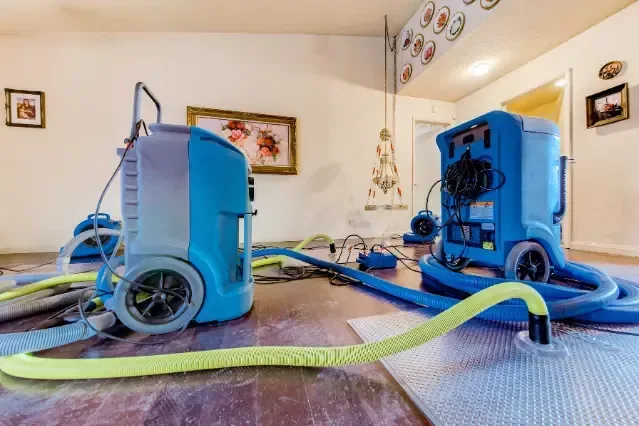
Four things every water job here gets
Dispatch around the clock
Active water is treated as urgent at any hour, and the response team rolls with truck-mounted extraction, air movers and LGR dehumidifiers.
Dried to IICRC S500
Equipment stays until framing, subfloor and drywall read within 2 to 4 points of a dry reference, not until the surface feels dry.
A claim file from day one
Moisture maps, daily psychrometric logs and timestamped photos taken before any demolition go straight into the insurance file.
Built for Triangle houses
Crawl spaces on slow-draining clay, shared townhome walls and attic water heaters all get checked, not only the room where water showed.
What to do first about structural drying and dehumidification
Measure every surface
Meters and thermal readings tag each wet area.
Position the machines
Fans and dehumidifiers go where readings run highest.
Reposition as it dries
Equipment shifts as walls and floors improve.
Confirm and release
Final readings beat the dry sample, then machines leave.
What does structural drying and dehumidification cost in Wake Forest, NC?
Drying one room generally costs $1,000 to $3,500. A group of rooms or a crawl space sits between $3,500 and $8,000, while slabs and hardwood may reach $16,000 or more since they give up water slowly.
- Fans and dehumidifier
- Meter checks
- Daily log
- Multiple setups
- Vented cavities
- Longer run
- Panel mats
- Slow release tracking
- Written drying record
How structural drying and dehumidification is handled, start to dry
Measure
Meters tag every wet surface.
Position
Machines go where readings run high.
Shift
Equipment moves as areas improve.
Release
Final numbers beat the dry sample.
Taking the puddle away does not dry the building. Studs, plywood and drywall keep absorbed water for a long time, and heavy summer air slows the release. Structural drying goes after that hidden water room by room.
What each machine contributes
The setup is a small system, not a pile of fans:
- Air movers sweep moving air across damp surfaces
- Dehumidifiers condense the water out of room air
- Panel mats and vents draw water out of hardwood
- Meters give each wet material a number to beat
Placement follows the readings rather than habit, and a machine leaves a room as soon as that room reaches its target.
Framing and subfloor stay wet long after the water is gone. A description of the loss lets the crew plan equipment placement.
Ask about drying machinesHot weather and slow drying
Summer highs in Wake Forest often reach the upper 80s to low 90s F, and the humid air gives wet wood little reason to let go of its water. Damp framing in that weather invites mold, so the work starts promptly.
- Windows and doors stay shut while machines run
- Wet carpet and padding leave the room early
- Cavities behind baseboards are opened for air
- Rooms with stubborn readings get extra machines
No fixed number of drying days is promised. The meter, not the calendar, decides when the machines go.
Rough numbers before anyone visits
The cost calculator and the drying time estimator give typical ranges for a loss like this one. The walkthrough and the moisture map set the real scope.
Closing out the drying
Before equipment is removed, each wet material is measured again and compared with a dry sample from the same building. Those numbers, with dated photos, go into the file for the carrier. The earlier stage is covered under water extraction, and the standard scope is described in the main structural drying service.
Structural drying and dehumidification across Wake Forest and nearby communities
Equipment goes into homes and shops across 27587, from the blocks near downtown to the streets off NC 96, and is repositioned at every visit as readings change.
The same service nearby: structural drying and dehumidification in Morrisville, Rolesville, Durham.
All water damage services for this town › · every area covered ›
Related water damage services
Structural Drying and Dehumidification questions
Water still showing up?
Framing and subfloor stay wet long after the water is gone. A description of the loss lets the crew plan equipment placement.
(888) 578-4720 Ask about drying machinesWhat separates drying from extraction?
Extraction removes standing water. Drying pulls out the moisture that wood, drywall and insulation have absorbed.
How is a finished job confirmed?
Wet materials are measured and compared with a dry sample from the same building.
Would box fans be enough for a wet room?
They move air but do not remove moisture, so the water simply moves into the room's humid summer air.
Why do machines stay for several visits?
Concrete, plywood and framing release absorbed water slowly, and stopping early leaves dampness behind walls and under floors.
Is hardwood dried the same way?
It needs panel mats and vents, and the pace is deliberately slow so the boards do not crack.
Can the machines run overnight?
They are loud but safe to run nonstop, and overnight operation is normally part of the plan.
Dry the building until the meter agrees
The drying team positions fans and dehumidifiers and tracks results until the numbers settle.
(888) 578-4720Set the machines