Structural Drying and Dehumidification in Morrisville, NC
Surfaces dry long before framing, subfloor and wall cavities do. The drying team sizes air movers and LGR dehumidifiers to the class of loss and keeps them running until every reading reaches the dry goal.
(888) 578-4720Ask for a drying plan built on readings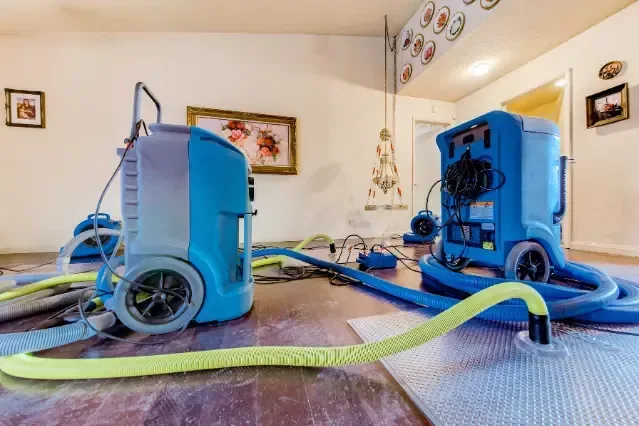
Four things every water job here gets
Dispatch around the clock
Active water is treated as urgent at any hour, and the response team rolls with truck-mounted extraction, air movers and LGR dehumidifiers.
Dried to IICRC S500
Equipment stays until framing, subfloor and drywall read within 2 to 4 points of a dry reference, not until the surface feels dry.
A claim file from day one
Moisture maps, daily psychrometric logs and timestamped photos taken before any demolition go straight into the insurance file.
Built for Triangle houses
Crawl spaces on slow-draining clay, shared townhome walls and attic water heaters all get checked, not only the room where water showed.
What to do first about structural drying and dehumidification
Keep the room closed
Shut windows so dehumidifiers can work.
Leave equipment running
Do not switch air movers off overnight.
Hold the thermostat steady
Keep the home at a normal room temperature.
Keep cords clear
Route foot traffic around the equipment.
What does structural drying and dehumidification cost in Morrisville, NC?
Structural drying here typically runs $1,000 to $3,500 for one room of equipment and monitoring, $3,500 to $8,000 for several rooms or a crawl space, and more when desiccant drying of slabs or hardwood is needed.
- Air movers
- LGR dehumidifier
- Daily readings
- Multiple LGR units
- Containment
- Psychrometric logs
- Desiccant drying
- Floor mats
- Extended monitoring
How structural drying and dehumidification is handled, start to dry
Map
Wet materials are measured.
Place
Air movers and dehumidifiers go in.
Log
Readings are taken every day.
Release
Equipment leaves when dry.
Structural drying is the part of water damage work that decides whether drywall, flooring and framing can stay. In Morrisville, humid summers make it harder: damp outdoor air slows evaporation, so a room has to be closed up and the air inside dried by dehumidifiers before wet materials give up their water.
How the equipment is sized
IICRC S500 sets the math, based on the class of loss and the room:
- Class 1: little water, low-porosity materials
- Class 2: a whole room, carpet and wall bottoms wet
- Class 3: water from above, walls soaked high
- Class 4: hardwood, plaster, concrete and crawl space framing
Air movers are placed along wet walls, and dehumidifier capacity matches the room volume and the class.
Walls and floors still damp? The drying team sets equipment to the readings 24/7.
Get a drying plan by phoneReading the drying every day
The drying team logs temperature, humidity and grains per pound inside and outside the drying area, plus readings on each wet material.
- Psychrometric readings to prove the air is drying
- Material readings against a dry reference
- Equipment moved as areas reach dry
- Thermal imaging to find pockets still wet
The EPA indoor air quality pages explain why lingering moisture matters for the air in a home.
Rough numbers before anyone visits
The cost calculator and the drying time estimator give typical ranges for a loss like this one. The walkthrough and the moisture map set the real scope.
When drying is finished
A structure is dry when materials read within 2 to 4 points of the same material in a dry part of the home, not when surfaces feel dry. That record goes to the adjuster with the photos. OSHA flood cleanup guidance covers safe work around wet structures and equipment.
Structural drying and dehumidification across Morrisville and western Wake County
Coverage spans ZIP 27560, from the Town Center and Shiloh out to Breckenridge, Kitts Creek, Crabtree Crossing and the homes and offices along Davis Drive, Aviation Parkway and McCrimmon Parkway.
Nearby coverage reaches Cary, Durham, Raleigh, Research Triangle Park, Apex, Holly Springs, Carrboro, Wake Forest, Rolesville.
Related water damage services
Structural Drying and Dehumidification questions
Water still showing up?
Walls and floors still damp? The drying team sets equipment to the readings 24/7.
(888) 578-4720 Get a drying plan by phoneHow long does structural drying take?
Usually three to seven days. Hardwood, plaster, concrete and crawl space framing take longer than drywall and carpet.
Why is structural drying equipment so loud?
Air movers push large volumes of air across wet surfaces. The noise ends when readings say the structure is dry.
Can I turn the drying equipment off at night?
No. Drying works around the clock, and switching off lets moisture settle back into materials.
What is an LGR dehumidifier?
A low grain refrigerant unit that pulls more water from the air than a household dehumidifier, even at lower humidity.
When is a desiccant dehumidifier used for drying?
For dense materials like concrete and hardwood, or cool spaces where refrigerant units slow down.
How do I know structural drying is finished?
Readings on wet materials match a dry reference within 2 to 4 points, logged and shared for the claim.
Still wet days later in Morrisville? Dry it right.
Materials that feel dry can still hold water in framing and subfloor until meters say otherwise.
(888) 578-4720Book structural drying